
By Sensei Rachel Matheney
It’s funny how when students first begin training in Kokondo they can’t wait to be an advanced student, which each student at some point in time learns is a relative matter. Nonetheless it seems like forever until the moment when one can finally feel relieved at the fact that he or she has learned quite a lot about Kokondo and can finally start feeling comfortable, at least I did. I seemed forever a rookie and always desiring to know more.
 Wanting to know more was the good thing but thinking that there would ever be a point when I would know it all or know most of it, or even know enough to feel comfortable was the issue. As I began to grow in my training the desire to become an advanced practitioner was replaced with the desire to learn more and more about each and every aspect that Kokondo had to offer. I no longer viewed advancement as a means of eventually ending the learning process but more as a gateway to deeper and deeper understanding, which quickly lead to the realization of the error in my original thought process. This inevitably lead to an analysis of what it truly means to learn and to know and what is the best way to develop my advancement and knowledge in Kokondo, without hindering my success through the wrong understanding of these topics.
What I eventually concluded was that to be successful in learning one must obtain and flourish in the beginner’s mind. I viewed and picked out some of the most positive aspects of being a beginner by observing others and myself, as I still consider myself a beginner. What I came up with was a few desirable traits that I believe a true beginner has and what a true Kokondo Ka strives to consistently grasp. These attributes are as follows; having a thirst and hunger for information, never being satisfied, striving to exceed one’s comfort zone, never thinking you know it all, and always assuming there’s more to learn.
 Thirsting for more is definitely a trait that all Kokondo Ka should have. By thirsting I mean having that feeling that without more information or training that one is figuratively thirsty and that thirst cannot be quenched but through new understanding or progression, which can be done through simply the repetition of a technique to discovering a nuance that was previously unknown, and obviously through many other methods. The point is that students with the beginner’s mind feel the need to always be actively participating in their training. Going through the motions simply won’t cut it for a person of this sort. A person with the beginner’s mind is always trying to overflow an ever-growing cup with more knowledge. It’s never enough or too much. If a beginner is not constantly feeding the brain with more knowledge, whether through physical repetition or mental understanding, then the student feels that this begins to starve his or her progress and as a result hungers for more. Without this feeling of thirst and hunger there is no compulsory driving force to achieve higher levels of understanding and development. However this quest and desire for more does not mean learning more and more techniques. This is what can separate a raw beginner, those who’ve been in the system for a limited amount of time and do not yet have the right mindset, from a student who truly has the beginner’s mindset, which is called shoshin (beginners mind). Many raw beginners often desire more and more techniques and sometimes do so above all else. They equate quantity of technique with knowledge and advancement. For those practicing beginners mind or shoshin it is not about quantity but rather quality, really getting to know more about what they already have learned so far. Getting another technique is the furthest from their minds. They leave that up to their Sensei to worry about. They trust the Sensei to know when to give them new techniques and they don’t stress over what comes next on a list of rank requirements. They would much rather spend their efforts on learning to become great at what they have already been given rather than trying to spread their efforts thin on a whole bunch of techniques that they aren’t even ready for. So instead of trying to obtain that next technique or next level they try to feed their brains and bodies with more understanding of what they have already been taught. In effect, the belts and attainment of new techniques are the summation of this described equation of shoshin. It is the result of advancement, not the means.
Being satisfied with one’s progress is never what a practitioner of shoshin feels. It’s not that one cannot have an appreciation (or even happiness and pride) for the progress that is made but to be satisfied with it is another story. Satisfaction implies contentment and if one is content there is not much of a motivating impulse to improve and strive for higher levels. This means advancement will be stagnant. Therefore the way to advance is never to be satisfied. Instead to always find something to work on. One should never become content with the knowledge or skill gained, but rather to acknowledge hard work and success and after each success to set further goals to deeper understanding and progression. By always establishing and updating goals it is fairly impossible to become satisfied since there is still something to work on. There is still something to tackle and to overcome.
A beginner, from the very first class, is pushed pass his or her comfort zone; everything from falling to learning how to kiai for the first time. Pretty much everything that is taught and expected of a beginner is unfamiliar and uncomfortable for the first few classes and so forth. This causes an explosion of new information and stimulus that one has never experienced but the student learns and develops at a steady and increasing rate as a result. If a student always stays within his or her own comfort zone then the student will never push him or herself to do new things and explore new aspects and levels of learning and understanding, which applies directly to physical and mental aspects. Think about it, if one never makes the effort to go through the mental exhaustion of trying to figure out Jushin (which is a continual process in and of itself) and instead just accepts it at it’s face value, as simply the line that splits the body in half then would that person truly ever understand what Kokondo techniques are all about and why they work? Or would a student really know what a good zenkutsu dachi is if the student never pushes that stance past the comfort of his or her own muscles? Sitting in the stance and pushing it past the comfort level allows a student to know what a good zenkutsu feels like but also it teaches the body to recognize a good stance. This all boils down to pushing past that comfort zone, getting comfortable with that push, and then pushing even further, then repeating the cycle over and over again.
 One should never think that he or she knows everything or that there will ever come a point in time when that will happen. This is one of the most dangerous and threatening thoughts that can hinder growth. The minute one starts believing that he or she knows everything there is to know about something, that’s when one stops learning about it. Learning requires active participation on the part of the student. The student has to recognize there is something to learn and then endeavor to discover it, and finally desire to understand it to deeper levels. That process cannot take place if the original recognition of ignorance to the topic does not exist. If you think there’s nothing left to learn then that’s what will be left for you. Nothing! I’m still learning new things about front double wrist grab and I look forward to having that same feeling in twenty, thirty years from now. The ongoing process of discovery and learning is one of things that make Kokondo and having the beginner’s mindset so much fun. For example, it’s been my experience that when students finally understand how to get both legs up in the air in Osoto gari and then are able to actually do it, their faces just light up and I can see the excitement that they feel. If one can understand that feeling or understand how it may feel one day to be able to do that, then imagine having that feeling the rest of one’s life. This is a start to understanding one of the reasons why Kokondo is so great.
Never thinking one knows everything goes hand in hand with assuming there is always something else to learn. One thing that can frequently happen with students is when they feel they have “gotten a technique” they assume the intellectual part of a technique is over or limited and now it’s just a matter of physical repetition and familiarity with a technique that leads to advancement. Although these are two important components to furthering one’s skills, it is not the end of intellectual understandings and discovery. There are so many different angles of analyzation through which to pick apart each technique. The discovery of these different angles can be an exciting and everlasting process through which advancement and higher understanding can take place. It’s what eventually allows a student to start and continue to understand the “cracks and crevices, nooks and crannies” of a technique or any aspect of Kokondo.
These are just a few features of having the beginner’s mindset, features that are everlastingly important to the development of any good Kokondo Ka. It took me a little bit to understand that it was not about knowing everything but more about the journey one takes in learning that really counts, and making sure that journey never ends. That’s what is truly important and what makes a student considered advanced. In fact an advanced student is really just a beginner at heart, one who is not happy until each technique and aspect of Kokondo is looked at and experienced through an infinite number of perspectives and angles.
 The concept of “change” is often perceived as a negative in the context of traditional martial arts. As a modern traditionalist this is not my view. The ability to flexibly adapt is a necessary requisite for long term success. Winston Church Hill once said, “there is nothing wrong with change as long as it’s in the right direction.”
 A young intellectual and student of classical jujitsu by the name of Jigoro Kano, understood the dilemma facing the art that he loved. Kano understood that in order for jujitsu to survive it needed to undergo some very radical changes. Kano’s assessment was that jujitsu; with a modification in approach (in terms of intent, technique, and public perception) could not only survive but also thrive in modern Japan and, eventually, the rest of the world. Kano began by viewing jujitsu in a larger context. No longer was it to be viewed as a form of (outdated) battlefield combat but as an endeavor that all people (children, women, and men of all social classes) could pursue in order to better themselves and society physically and mentally. In this vein he eventually decided to de-emphasize the term jujitsu (gentle art) in favor of the more encompassing judo, or gentle way. Many today view judo as its own art, separate from jujitsu (a highly debatable point). However, at the time, judo was seen as a new approach to the same art. The terms jujitsu (or jiu-jitsu) and judo were often used interchangeably referring to the same art (in early days, Kano’s art sometimes erroneously referred to as Kano Jiu-Jitsu). Of course, Kano faced some resistance in these changes – but over time the majority of jujitsu schools merged into his school – the Kodokan. In fact, other arts, such as Gichin Funakoshi’s school of karate (Shotokan) adopted some of the same changes as it pertains to an academic approach to martial arts.
 Kano also devised an academic method of ranking students progress through a system of kyu & dan that were represented by colored belts. The kyu ranks were represented (over time) by variety of colored belts and a black belt symbolized the dan ranks. This system has been adopted almost universally in modern martial arts systems (gendai budo). This ranking system allowed students to track experience and expertise without the having to engage in actual combat (as in the classical schools). It also was a method of allowing students to set both short and long-term goals. Having a set of pre-determined markers motivated students in their ongoing progress while studying the art of judo. Again, the motivation was no longer simply a matter of day-to-day survival as it had been for the warriors who studied classical jujitsu.
 Due of the relative safety at which students could practice full speed, full power techniques in Judo, Kano included randori (freestyle practice or sparring) and shiai (randori as an actual competitive contest) as an important facet of judo. In addition to randori as a means to test each student’s spirit of self-improvement and as a “laboratory” to test one’s techniques – Kano felt it was an important method of training in lieu of the reality of actual combat. Surely, Kano realized that randori did not encompass the entire scope of an actual combative encounter. Nonetheless, he believed that the ability to match techniques against someone of comparable skill in a circumstance that allowed for full resistance was a useful tool in conjuring up the realism of combating someone who has the same objective you do and can use all the same skills you can. It was, in some way, a method of objectively testing one’s skill. If one’s only mode of practice was that of pre-arranged attacks and defenses, it could breed a type of false confidence in one’s abilities. If, on the other hand, one was consistently beaten in randori it made it difficult for them to think they were better then they actually were. Kano viewed this as a positive development, so long as it was kept in balance with the other methods of practice, including kata, and the other facets of Judo (self defense & physical/intellectual education).
 In 1959 a young American martial artist and marine who had practiced both a little known family form of classical jujitsu (sanzyuryu jujutsu) as well as Kodokan Judo saw the need for change. Shihan Paul Arel saw that not only was Judo becoming out of balance but there were also attempts by some Judo instructors to pass off instruction in the art of ‘jujitsu’ by simply incorporating a few sloppy strikes into the Judo syllabus. A young Shihan Arel began to formulate an approach to jujitsu that took the many positive changes and innovations that Kano had developed in the art of judo (coupled with contributions from other sources) and reapplied them back to the original art and intent of jujitsu.
 Jukido includes the entire nage-waza (throwing techniques) of Kodokan Judo, although some variations of throws are eliminated if they are designed solely for competitions and are dangerous to attempt in actual self defense. The methods of practice, such as uchikomi and nagekomi are emphasized. The principles of kuzushi (off-balancing), tsukuri (set up), and kake (execution) are also central in Jukido Jujitsu. At higher ranks, older style jujitsu techniques are also incorporated under close supervision of senior sensei. These throws are always introduced within the construct of pre-arranged self-defense techniques and gradually in random self-defense situations with increasing levels of resistance from training partners.
 They surround me and their ragged breath envelopes me. They scowl at me and I see they will attack me at any moment. They are three large men, all with the intent of harming me. Why am I not afraid? Well, I could say it’s because I train in Jukido Jujitsu, a powerful form of self defense. And that would be true. But I’m also in the dojo, and the people beginning to attack me are my training partners and my friends. I have to push that thought out of my mind, however. To me they are my mortal enemies. I need to use their energy against them. Because using our opponent’s energy against them, using it to our advantage, is what Jukido is all about. Sankosho, the official Kokondo guidebook, defines ki as “use of inner force.” In other words, ki is our internal energy. Ki is such an essential part of our art that it is also part of our style’s name, Jukido. Without ki, we would have no kuzushi or Jushin, major principles of Jukido Jujitsu. Jukido-ka are able to take their experiences with ki outside of the dojo, which can be called mental kuzushi. It is this same energy, in the form of motivation, that enables one to reach their shodan and beyond.
 Outside of the dojo, we can use someone’s mental energy and use it the same way we use kuzushi in the dojo. For example, refusing to get angry with someone when they are angry with you is an example of mental kuzushi. Instead of taking the force of their verbal blows head-on, one would stay polite and use their anger against them, or at least declining to take the bait they set for you. Instead, simply walk away and ignore them, or say something that would not anger them further. Say something that wouldn’t give them any power over you, don’t let them see that you’re angry. This is another simple way to use ki. Also, doing things when you are told is a way of using ki in the form of mental kuzushi. Instead of resisting, go with your boss’s energy. It saves a lot of energy from being wasted. You’re going to do whatever it is in the end, anyway. Why waste breath and possibly get in trouble on the way?
 The summer I turned 13 my friends and I would often spend our Saturdays by jumping on a bus and heading down to Chinatown in Washington DC. We would go to catch the 12 hour Martial Arts movie marathons that frequented DCs Chinatown theaters. Once the bus let us off and hopefully before the movies started we would work our way through the little shops that carried a curious jumble of all things Asian. Among their wares they would stock apothecary supplies, Asian works of art, clothing, piles of Shark fins, Chinese pottery, cotton soled shoes, incense – you name it, but most importantly they carried a giant selection of Martial Arts supplies. We got to handle steel chain dart whips, throwing stars, three section staffs, nun chucks, uniforms, sashes, real tiger balm (to make you hands hard as iron!), and books on every exotic Martial Art under the sun. We of course touched everything at least once, dreaming of the day we would be martial arts masters. One of the Chinese shop owners would sometimes give us small demonstrations in the Kungfu School he ran next to his shop on how a certain weapon might be used (and point out the appropriate book to purchase along with it). He was absolutely amazing to watch in action. We would ask him to teach us some small move to get us started but in his broken English he would tell us that the Secret was in the book or in Class. So we gave him our yard cutting money and purchased staffs, nun chucks, darts, any number of Martial Arts gizmos as well as the appropriate books and apparel.
 I would go further by sighting my own experience with Jukido by saying that although you’re Sensei can guide your daily training régime he cannot hold your hand and encourage you outside the Dojo. You must take personal responsibility for your training and act accordingly if you intend to progress.
 As I sit here and write this, I wish that there would be a single story or memory that I could recount to provide testimony to the extraordinary life that Shihan Arel lead. I can’t. Perhaps this is because there are simply too great a number of lasting memories of such a wonderful man to be contained in just a single story or two.
 This trip was difficult for him and it in my heart I knew it would be his last. However, you wouldn’t have known it simply talking to him and receiving his masterful instruction. At this seminar and throughout his life, he showed me real strength – strength through gentleness. At his weakest physically, he was stronger then I had ever seen him. He was the definition of a warrior. His life was an living example of Bushido. We’ve shared many moments together, but these final days together were of immense significance as he expressed his pride in me personally and in our dojo in such an emphatic way.
 There is so much I can say…but nothing seems to be enough. I will conclude with what my most senior student, Rachel Matheney, wrote of Shihan Arel on our dojo’s behalf. These words were presented to him, along with a variety of Kokondo photos, in a frame during our final dinner together at the conclusion of our seminar. Although words are not enough, I feel these words are the best we can do:
 First and foremost, the martial arts of Kokondo do not focus on the application of martial arts techniques for sport (MMA, Point Karate, Judo, etc.), but rather focus on the application of these arts in realistic self-defense for civilians. As such, the focus of the training deals much more with the prospects of dealing with a gun disarm, a surprise attack in a parking lot, child abduction, or a rape situation.
  Lastly, although the term “mixed” martial arts originally referred to the idea of various styles “mixing it up” in this type of competition (judo vs. karate, boxing vs. taekwondo, etc.), today that really isn’t the case. In that sense, the name is almost a misnomer. Today the typical MMA figther practices in a base of wrestling, muay thai, brazilian jiu-jitsu, and boxing – and then practices applying it towards the unifed rules of MMA. There are some who deviate from that, but as a general rule – that is what MMA “is.” Although there are some exceptions, the overwhelming majority are now training in “MMA” itself as opposed to something else and then trying to compete with it in an MMA match. This is the natural progression. If you want to prepare for Olympic Judo competition, you don’t go to an MMA gym – you go to a Judo dojo. If you want to train and compete in MMA, it would be unwise to train in Judo under the rules of the Olympic Judo Committee. Two different sports, which prepare you for different rules and environments. This goes back to the first point – most who want to compete will seek out a style conducive to this. If one wants to learn self-defense as the number one priority, they will seek out an appropriate system – be it Kokondo Karate, Jukido Jujitsu, Krav Maga, etc.
 Asker’s Comment:
 Sensei George Rego
 Japanese martial arts are divided into two separate and very distinct categories; Bujutsu and Budo. Bujutsu is the older of the two and are quite literally the “martial arts” of Japan with goal being the absolute effective application of fighting techniques in combat. Budo is the younger of the two categories and traditionally there is no budo form of an art without its bujutsu parent. The budo are literally the “martial ways” of the Japanese fighting arts. The budo or martial ways, in contrast to bujutsu, are far less concerned with practical and realistic application of techniques in the modern age, but much more focused on the perfection of the moral fiber of the individual budo student. In essence, the goal is to translate what the student learns in the dojo and apply it to everyday life. One famous statement by Karate master, Sensei Gichin Funakoshi summarizes the budo ideal clearly, “The ultimate aim of Karate lies not in victory or defeat, but in the perfection of the character of its participants.”
 In the last few decades most of the budo have focused on sports and competition as the vehicle to self-perfection. This has resulted in not only unrealistic application of technique but the watering down of the “ideal” approach to budo. Budo forms that emphasize competition focus on scoring points and many of the older (more effective and dangerous) techniques are not allowed due to rules and regulations. This limits the student in terms of actual self-defense, where there are no competition guidelines. Even worse, the role of traditional sensei or teachers is being replaced with that of “coach.” These sensei/coach’s then begin to stress that budo and competition is about winning trophies for themselves and their schools – the emphasis becomes much more on beating the other team. This is not in line with the traditional ideal of budo, in which the only competition, was the competition with one’s self. This is drastically different from Master Funakoshi’s early emphasis on perfection of self rather then victory or defeat. Many modern schools and budo claim that they still follow the traditional or ideal path in which the perfection of one’s self is the goal – but actions speak louder then words – more often then not in these schools one will find the discussion much more on successful tournament strategy and not on self-perfection. The students who receive the most instruction are those who bring trophies back to display on their schools front window. These arts have grown to be “martially inspired arts” and are no longer true budo or bujutsu.
 Learning traditional martial arts techniques without a proper philosophical foundation is not only dangerous but irresponsible. As Kokondo martial artists dedicate their training time to perfecting the physical techniques of Kokondo, they equally focus on living their lives in an honorable and noble way, fitting of a modern warrior. With power comes even greater responsibility, Kokondo martial artists understand this and embrace this very essential responsibility.
 In many ways, today’s modern way of living is a far cry from the days when the warrior and non-warrior viewed this code as the most sacred and honorable way to live. Yet, with an updated perspective, one couldn’t find virtues more beneficial than these. Kokondo sensei worldwide work to instill this code in their students as an importance and essential counterweight to the martial techniques the students learn. In Kokondo the code of Bushido is held in the highest regard. Kokondo treats both sexes as equals, bigotry, racism, or discrimination of any kind is not tolerated. The long term success of any Kokondo student, in the dojo or in life, is very directly linked to his/her adherence and embrace of this powerful way of life – The way of the warrior; Bushido.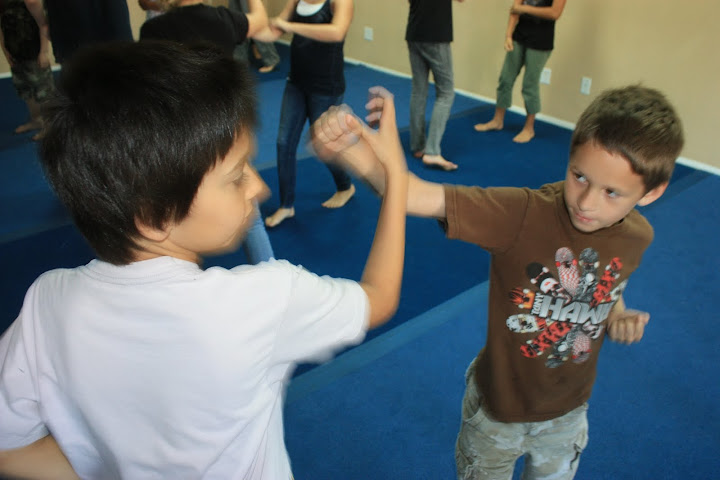

 In promoting this message of permission, coupled with the physical martial arts skills, as parents we empower our children and eliminate those key moments of physical and mental hesitation. The child, at that critical moment, doesn’t have to weigh the pros and cons of confronting a bully. He has a clear understanding of what he has and doesn’t have permission to do and knows that he has the blessing of his parents to do what is right. Fight back against bullying!
 In my position as Chief Instructor at the Jukido Academy I’ve had many intense telephone and in-person conversations with parents who are looking to either proactively prevent their child from being bullied or, in many unfortunate cases, are looking to stop the bullying their son or daughter is currently encountering. Many parents feel as if they have followed all of the administrative steps encouraged by their schools with no real results and see their children’s confidence (and safety) tanking.
 This is because when individuals (young or old) have the confidence in their physical capability to deal with bullies they walk with a different type of posture, speak with a stronger tone of voice, and know that if they are confronted by an attacker – they have to tools to deal with it! In Jukido Jujitsu this confidence is not build on a false foundation that is sometimes built in more competitive/sport-based martial arts. In these arts students are in tournaments competing against students of the same age and weight-class (to ensure that everything is “fair play”).